Selecting the lifting capacity of a rubber tyred gantry (RTG) crane is not simply a matter of choosing a crane that can lift the heaviest load in the yard. The more important question is how much capacity margin should be kept between the maximum expected load and the crane’s rated capacity.
A crane that is too close to its rated limit may have little flexibility when actual operating conditions vary. On the other hand, choosing a much higher-capacity RTG than necessary can increase the purchase price, structural weight, power requirements, and long-term operating costs without providing a practical benefit.
For most rubber tyred gantry crane applications, the right capacity margin is determined by the actual load profile, spreader or lifting attachment weight, operating conditions, load distribution, duty cycle, and future expansion plans. A practical selection process should therefore start with the real operating load rather than an arbitrary percentage.
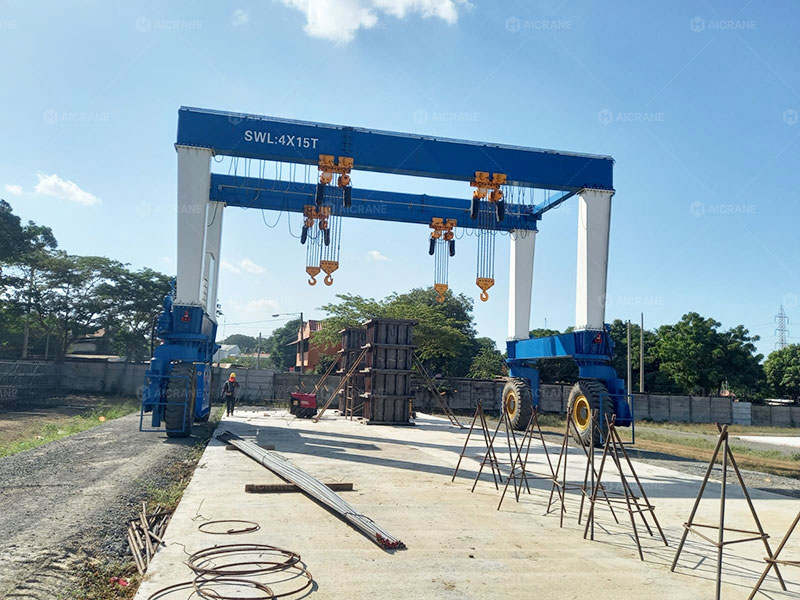
What Does Capacity Margin Mean for an RTG Crane?
Capacity margin is the difference between the RTG crane’s rated lifting capacity and the maximum load that the crane is expected to handle during normal operation.
For example, suppose an RTG is rated at 40 tonnes and the heaviest cargo to be handled is 34 tonnes. The nominal capacity margin is:
40 t − 34 t = 6 t
This represents a 15% margin relative to the crane’s rated capacity.
However, this calculation can be misleading if the 34-tonne figure represents only the cargo weight. The crane must also account for the weight of the spreader, lifting beam, hook block, or other lifting equipment included in the suspended load.
If a 34-tonne cargo is lifted with a 6-tonne spreader, the total suspended load becomes approximately 40 tonnes. In that situation, a 40-tonne RTG does not actually have a 15% margin. It is already operating at its rated capacity.
This is why the first step in determining capacity margin is to establish exactly what the crane’s rated capacity refers to and what components are included in the lifted load.
Start With the Maximum Actual Load
The most reliable approach is to identify the maximum load that the RTG will regularly handle rather than using the average load.
Consider a container yard where the operating profile is:
- Typical container weight: 24–28 tonnes
- Heavy containers: 30–32 tonnes
- Maximum expected container weight: 34 tonnes
- Spreader weight: 5–7 tonnes
If the RTG is required to handle a 34-tonne container using a 6-tonne spreader, the total suspended load can approach 40 tonnes.
In this case, specifying a 40-tonne RTG would leave almost no practical margin.
A 45-tonne RTG may provide a more appropriate configuration if the gantry crane manufacturer confirms that the rated capacity and load chart are suitable for the intended lifting arrangement.
The important point is that the capacity margin should be calculated from the complete suspended load, not cargo weight alone.
Do Not Treat a 10% or 20% Margin as a Universal Rule
A common approach during preliminary equipment selection is to add 10%, 15%, or 20% to the maximum expected load. This can be useful as a starting point, but it should not be treated as a universal engineering requirement.
For example:
If the maximum complete suspended load is 30 tonnes:
- 10% margin → approximately 33 tonnes
- 15% margin → approximately 34.5 tonnes
- 20% margin → approximately 36 tonnes
A 35-tonne crane might therefore appear reasonable for a 30-tonne load.
But the same calculation may not be appropriate if the crane operates continuously at high duty, frequently handles loads near the maximum capacity, or needs to accommodate future heavier containers.
Conversely, a 40-tonne RTG may be unnecessary if the maximum actual suspended load is only 25 tonnes and there is no realistic plan to increase it.
The percentage is therefore only one part of the decision.
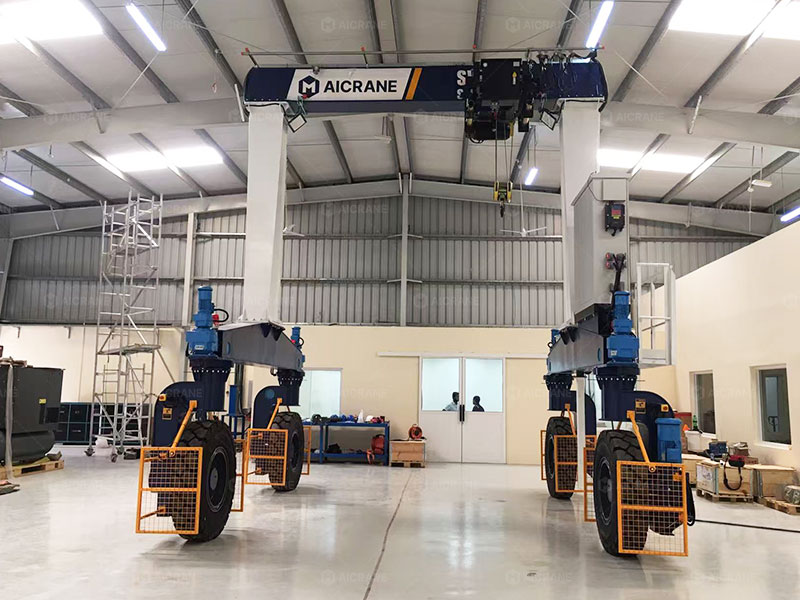
Factor 1: Spreader and Lifting Attachment Weight
One of the easiest mistakes to make during RTG selection is to specify capacity based only on the container or cargo weight.
For container handling, the spreader itself contributes to the suspended load. Depending on the equipment configuration, the weight may be several tonnes.
For example:
Container = 30 t
Spreader = 6 t
Total suspended load = 36 t
A buyer who specifies a 30-tonne RTG based on container weight would be selecting equipment that cannot safely accommodate the actual suspended load.
For non-container applications, the same principle applies to:
- Lifting beams
- Hooks
- Magnets
- Grabs
- Special lifting frames
- Slings and rigging components
These weights should be established before the required crane capacity is finalized.
Factor 2: How Often Will the Crane Handle Heavy Loads?
Two yards may have the same maximum load but require different capacity strategies because their operating patterns are different.
Imagine two RTGs rated at 40 tonnes.
In Yard A, 35-tonne loads are handled only a few times per week. Most loads are between 15 and 25 tonnes.
In Yard B, 35–38-tonne loads are handled continuously throughout every shift.
The second application places much greater demand on the crane.
Frequent operation close to the rated capacity can affect component loading, thermal conditions, braking requirements, and maintenance intervals. The duty classification and operating cycle therefore need to be considered together with rated capacity.
If heavy loads are routine rather than occasional, selecting a crane with additional capacity can provide more useful operating flexibility.
Factor 3: Dynamic Effects During Lifting and Travel
The load on an RTG is not always perfectly static.
During lifting, acceleration, deceleration, trolley movement, and crane travel, dynamic effects can influence the forces experienced by the structure and mechanical components.
This does not mean that buyers should simply add an arbitrary percentage for “dynamic load.” Dynamic effects are normally addressed through the crane’s engineering design, applicable standards, load combinations, control system, and duty classification.
Instead of adding a large safety percentage on top of the rated capacity, buyers should ask the manufacturer how the crane is designed for the actual operating cycle.
For example, an RTG with frequent starts and stops, high travel speeds, and intensive container handling may require a different mechanical and electrical configuration from a crane that performs occasional low-speed lifting.
Factor 4: Off-Center and Uneven Loads
The heaviest load is not necessarily the only load that matters.
An RTG can encounter uneven load distribution when cargo inside a container is not uniformly positioned or when special loads are suspended using lifting beams or other attachments.
For example, a 30-tonne load with a relatively balanced center of gravity may behave very differently from a 30-tonne load with a significantly offset center of gravity.
The crane’s structural design, spreader arrangement, lifting mechanism, and operating procedures must account for the intended load conditions.
For specialized RTG applications, the buyer should provide the manufacturer with information about the center of gravity and possible load distribution rather than relying solely on total weight.
Factor 5: Future Load Requirements
Future expansion is another reason to consider capacity margin.
Suppose a yard currently handles containers with a maximum gross weight of 30 tonnes, but the operator expects heavier cargo or different container flows within the next five to ten years.
Buying a crane with almost no capacity margin could create limitations later.
However, purchasing a substantially larger crane solely because “the yard may expand someday” is also difficult to justify.
A better approach is to identify realistic future requirements.
For example:
Current maximum suspended load: 32 t
Expected future requirement: 36 t
A 40-tonne RTG may provide a more useful long-term configuration than a 35-tonne model.
But if the expected future requirement is still below 32 tonnes, increasing the crane capacity substantially may add cost without providing meaningful value.
A Practical Capacity-Margin Example
Consider a container terminal planning to purchase an RTG with the following operating conditions:
- Maximum container gross weight: 32 tonnes
- Spreader weight: 6 tonnes
- Maximum suspended load: 38 tonnes
- Typical operating load: 22–28 tonnes
- Heavy-load frequency: approximately 10% of lifts
- Future maximum expected suspended load: 40 tonnes
A simple selection based on today’s maximum load might suggest a 40-tonne RTG.
But the situation deserves closer examination.
The 40-ton gantry crane would operate at approximately 95% of its rated capacity when handling the current maximum suspended load:
38 ÷ 40 × 100% = 95%
There is almost no additional capacity available.
If future suspended loads reach 40 tonnes, the crane would be operating at its rated capacity.
A 45-tonne RTG would reduce the current maximum-load ratio to:
38 ÷ 45 × 100% ≈ 84.4%
And the future 40-tonne load would represent:
40 ÷ 45 × 100% ≈ 88.9%
This does not automatically mean that 45 tonnes is the correct choice. The final selection still depends on the manufacturer’s design, duty class, spreader configuration, load combinations, yard layout, and applicable standards.
But it illustrates why looking only at the difference between cargo weight and rated capacity can produce the wrong conclusion.
Capacity Margin Is Not a Substitute for Proper Crane Design
A larger rated capacity does not automatically make an RTG safer or better.
If a 50-tonne RTG is used for loads that rarely exceed 25 tonnes, the additional capacity may provide little practical benefit. The heavier crane structure can also affect wheel loads, ground pressure, travel performance, power consumption, and purchase cost.
The crane should therefore be designed around the complete operating envelope.
Important parameters include:
- Rated lifting capacity
- Spreader or attachment weight
- Maximum load dimensions
- Lifting height
- Span
- Container stacking configuration
- Duty classification
- Lifting speed
- Trolley speed
- Crane travel speed
- Working hours per day
- Number of lifting cycles
- Ground and pavement conditions
- Power supply
- Environmental conditions
Capacity is only one part of the overall RTG specification.
How Much Capacity Margin Is Usually Reasonable?
For a preliminary budget or feasibility study, a margin in the range of roughly 10–20% above the maximum expected complete suspended load can be a useful starting point.
However, this should not be interpreted as a fixed engineering rule.
A margin closer to the lower end may be reasonable when:
- Maximum loads are well defined
- Heavy loads are relatively infrequent
- Future load growth is limited
- The operating environment is predictable
- The crane is properly engineered for the duty cycle
A larger margin may deserve consideration when:
- Load weights are uncertain
- Heavy lifts are frequent
- Future cargo requirements are expected to increase
- Special lifting attachments may be introduced
- The operating cycle is intensive
- The mobile gantry crane needs greater flexibility for changing yard requirements
The final rated capacity should always be confirmed through the crane manufacturer’s engineering calculation and the applicable design and safety requirements.
Questions to Ask an RTG Crane Supplier
Before selecting a capacity, buyers should provide the supplier with more than just a number such as “40 tonnes.”
A useful technical inquiry should include:
- What is the maximum cargo weight?
- What is the weight of the spreader or lifting attachment?
- What is the maximum total suspended load?
- How frequently will the maximum load be handled?
- How many working hours are expected per day?
- How many lifting cycles are expected per hour?
- What are the current and future load requirements?
- What container stacking configuration is required?
- What lifting height and span are required?
- What duty classification is required?
- Are there special load distributions or off-center loads?
- What ground and pavement conditions exist at the site?
With these details, the manufacturer can determine whether the proposed rated capacity provides an appropriate operating margin.
Final Takeaway
There is no single capacity-margin percentage that fits every rubber tyred gantry crane.
For preliminary RTG selection, 10–20% above the maximum expected complete suspended load can be a useful starting point, but the final decision should be based on the actual load profile and operating conditions.
The most important calculation is not:
Maximum cargo weight × 1.10 or 1.20
It is:
Cargo + spreader/attachment + actual operating requirements + realistic future load demand
A well-selected RTG should have enough capacity to handle the intended loads without routinely operating at the upper limit, while avoiding unnecessary oversizing.
For a customized RTG configuration, provide the required capacity, span, lifting height, stacking arrangement, working hours, load profile, power conditions, and site requirements. These details allow the crane supplier to determine an appropriate rated capacity and configuration rather than applying a generic capacity margin.